How Long Does Dental Insurance Verification Take?
On this page
- How long does one dental insurance verification take?
- How far in advance should you verify dental insurance?
- What makes one verification take longer than another?
- How much front-desk time does verification take across a full day?
- How does automation change the time?
- Frequently asked questions
- The three clocks, in one place
One dental insurance verification takes about 10 to 20 minutes of staff time by phone or payer portal, 10 minutes or less through an outsourced service, or seconds through a real-time API or EDI 271 feed. The method decides the number, because each one measures a different thing. Separate from all of that, most offices verify 48 to 72 hours (2 to 3 business days) before the appointment.
Key Takeaways: A single verification runs about 10 to 20 minutes of staff time by phone or portal, 10 minutes or less through an outsourced service, or seconds through a real-time API or EDI 271 connection. Most practices verify 48 to 72 hours (2 to 3 business days) ahead. Across a full schedule, manual checks can absorb several hours of front-desk time a day.
The honest answer is that it depends on how you verify. The spread runs from seconds to twenty minutes a patient, and the difference is not small. Front-desk teams lose hours to this every week, yet few pages state the number plainly. Here is the time each method takes, how far ahead to verify, and where the day actually goes.
| How it is done | Time it takes | What the number measures |
|---|---|---|
| By phone with the payer | about 10 to 20 minutes per patient | front-desk labor time, longer with hold times |
| Through a payer web portal | about 10 to 20 minutes per patient | front-desk labor time |
| Through an outsourced verification service | about 10 minutes for a soft check, full breakdown often within the hour, 24 to 48 hour standard turnaround | the service's own turnaround, off your team's clock |
| Through a real-time API or EDI 271 feed | seconds (about 10 to 30 seconds) | the electronic response time |
How long does one dental insurance verification take?
The number depends entirely on the method, so keep each figure attached to its method.
By phone with the payer: about 10 to 20 minutes per patient. This is the slowest path, and it is the one most offices still use. You navigate an IVR menu, wait on hold, then read benefits back to a representative one field at a time. A busy day or a payer with long queues can stretch a single call well past twenty minutes.
Through a payer web portal: about 10 to 20 minutes per patient. Logging in and reading benefits is faster than a phone tree, but you repeat it per payer, and each portal looks different. Passwords expire, sessions time out, and some payers still route you back to the phone for detail.
Through an outsourced verification service: about 10 minutes for a soft check, with a full breakdown often returned within the hour and a 24 to 48 hour standard turnaround. That number is the service's turnaround, so your staff spends near zero minutes on it.
Through a real-time API or EDI 271 feed: seconds. An electronic eligibility request returns in roughly 10 to 30 seconds. Industry guides report the same gap: an automated check answers in seconds while a manual check by phone or portal runs roughly 10 to 20 minutes (mConsent, Medusind).
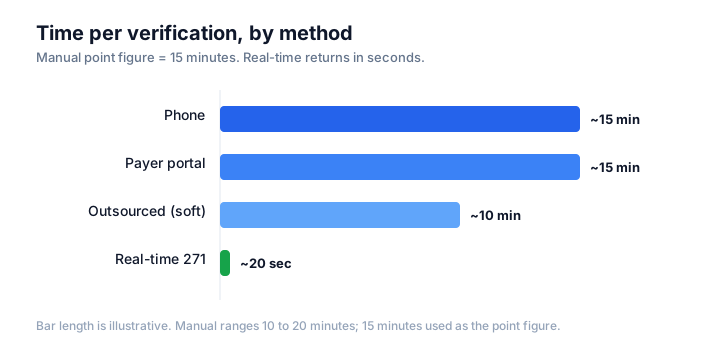
Phone runs longest for a simple reason. It stacks three delays that the other methods avoid: an IVR menu, hold time, and a spoken read-back you cannot skim.
How far in advance should you verify dental insurance?
Verify 2 to 3 business days (48 to 72 hours) before the appointment. That is the standard most offices follow, and it holds no matter which method you use (Dental Intel).
The advance window exists to give you room to fix problems. If coverage lapsed, the plan changed, or the member ID is wrong, you want to know while there is still time to call the patient. Catch it two days out and you can update the file, adjust the treatment estimate, and collect the right amount at check-in.
Same-day and last-minute appointments are the exception. There is no two-day buffer for a patient who books this morning, so a real-time check matters most in those slots. An electronic verification answers before the patient sits down, which is why urgent and add-on appointments are the strongest case for automation.
What makes one verification take longer than another?
Three things drive the spread: hold times, plan complexity, and how much benefit detail you actually need.
Confirming that coverage simply exists is fast. Any method can tell you active-or-not in a minute or two. The time goes into the full read. A complete benefits breakdown includes annual maximums, deductibles, coverage percentages by category, frequency limits, waiting periods, downgrades, and missing-tooth clauses. Pulling all of that by phone means asking for each field and writing it down.
Plan complexity compounds it. A straightforward PPO reads quickly. A plan with category-specific frequencies, a waiting period on major work, and a downgrade on posterior composites takes longer to capture and longer to record correctly. If you want the level of detail your billing team needs at check-in, plan for the longer end of every range. Our verification checklist walks through the full benefits breakdown field by field.
How much front-desk time does verification take across a full day?
At roughly 15 minutes a check, the day adds up fast. Do the arithmetic:
20 patients per day x 15 minutes per check = 300 minutes, about 5 hours.
Across a five-day week, that is about 25 hours. That is most of one person's shift spent on verification alone. The same coordinator is also answering phones, checking patients in, scheduling, and collecting balances. Verification competes with all of it, so the careful benefits read is the task most likely to get rushed or skipped when the lobby fills up.
This burden shows up in the survey data. In Zentist's 2026 Dental RCM Trends Report, a survey of 160+ dental billing professionals, 71% named real-time insurance verification their top daily challenge (Zentist via Dentistry Today). Industry guides put weekly verification load in the range of several hours per office, and the exact figure climbs with patient volume.
How does automation change the time?
Automation compresses a check from about 15 minutes to under a minute, and it runs in the background before the appointment. A real-time API or EDI 271 feed sends the eligibility request and returns benefits in seconds, so no one sits on hold. Point it at tomorrow's schedule and the day arrives with benefits already attached to each patient.
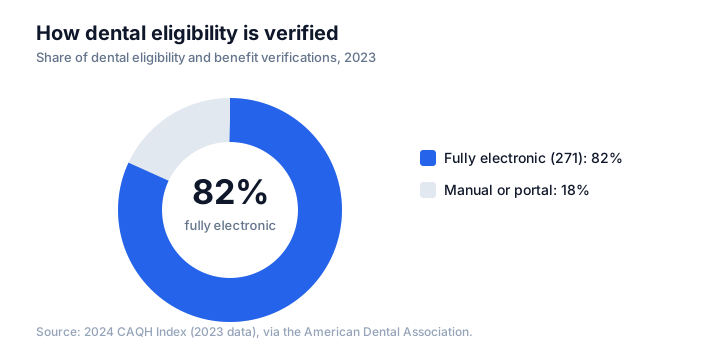
The shift is already industry-wide. Dental eligibility and benefit verification reached 82% fully electronic in the 2024 CAQH Index (Dental Plan Adoption table). The manual and portal remainder is where the front-desk minutes still go.
That is where the 5-hour manual day turns back into productive front-desk time. The coordinator reviews flagged exceptions instead of dialing every payer, and the routine checks clear themselves.
Small practices get the most out of this framing. A one-to-three-chair office rarely has a dedicated verification specialist, so the whole load lands on one person at the front desk. A done-for-you verification layer gives that office the same speed a large group buys with an in-house billing team, which is exactly the fit we build for. It reads the schedule, runs the electronic checks automatically, and routes judgment calls (frequencies, waiting periods, missing-tooth) to a person.
Frequently asked questions
How many days before an appointment should you verify dental insurance? Two to three business days ahead is standard. That leaves time to fix a lapsed plan, a wrong member ID, or a changed benefit before the patient arrives. For same-day bookings, a real-time check covers the gap.
How long does it take to verify insurance by phone versus online? Both run about 10 to 20 minutes per patient. Phone tends toward the longer end because of IVR menus and hold times. A payer portal skips the phone tree, but you still read and record benefits by hand, once per payer.
Can dental insurance be verified in real time? Yes. A real-time API or EDI 271 eligibility feed returns benefits in about 10 to 30 seconds. It is the fastest method available and the best fit for same-day and last-minute appointments.
How much front-desk time does insurance verification take per day? At roughly 15 minutes per check, a 20-patient day absorbs about 5 hours. That competes directly with phones, check-in, and scheduling handled by the same person, which is why the detailed read often gets rushed.
The three clocks, in one place
Insurance verification has three separate clocks, and blending them is what makes the answer feel fuzzy. The first is time per check, which runs from seconds by API to twenty minutes by phone. The second is the advance window, a steady 2 to 3 business days ahead no matter the method. The third is the daily total, which reaches about 5 hours on a full manual schedule.
Name each clock and the workload stops being a mystery. If your team is spending hours a day on the first clock, that is the one automation resets. Read our full dental insurance verification guide for the complete workflow, or see how the done-for-you verification service handles the schedule for you.
Published by Ivory Automation, custom back-office automation for independent dental practices.